
Cali wins the 2026 Shanghai Award and brings its model for comprehensive habitat improvement to the global stage
-
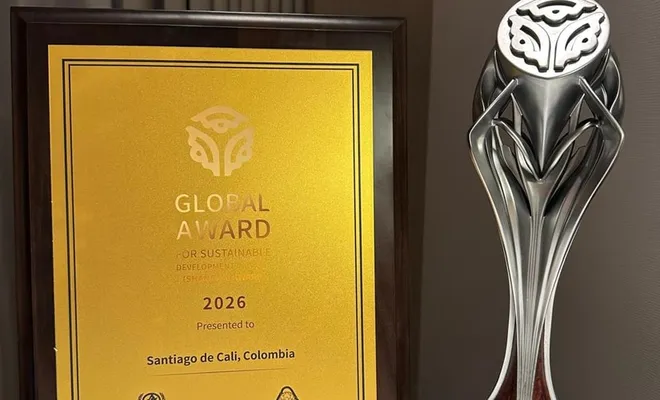
The capital of the Valle region was selected from 92 entries across 34 countries, becoming one of the five winning cities of the Shanghai Award 2026 an international recognition for initiatives that promote sustainable urban development.
-
Under the leadership of Mayor Alejandro Eder, the public policy for "Comprehensive Habitat Improvement" advanced through projects such as Charco Azul and El Pondaje, the Figueroa Boulevard, and the formalization of informal urban settlements have established Cali as an international benchmark for territorial transformation.
Santiago de Cali, November 3, 2026
Cali continues to capture the world’s attention this time for its progress in sustainable urban development. The capital of the Valle del Cauca department has won the 2026 Shanghai Award, an international recognition presented by the United Nations Human Settlements Programme (UN-Habitat) and the Municipality of Shanghai, China, to cities that champion solutions for building more inclusive, resilient, and sustainable territories.
The announcement was made during the World Cities Day celebrations in Fuzhou, China. Cali was one of five winning cities alongside Addis Ababa (Ethiopia), Istanbul (Turkey), Jingdezhen (China), and Katowice (Poland) selected from 92 entries across 34 countries.
Impact, innovation, sustainability, and adaptability were the four criteria used by the international jury to evaluate the initiatives submitted by each city. In Cali’s case, the projects at Charco Azul and El Pondaje, the Figueroa Boulevard, and the efforts to formalize urban settlements led by the District Administration under Mayor Alejandro Eder served as the city’s primary credentials for the award.
According to UN-Habitat, Cali’s model stands out for integrating housing solutions, land tenure regularization, public services, ecological restoration, and risk reduction, with local communities serving as the driving force behind urban development.
Impact, innovation, sustainability, and adaptability were the four criteria assessed by the international jury, which recognized Cali for its comprehensive approach to addressing urban challenges and fostering more equitable territories.
“This award is a result of all the work we have been carrying out regarding housing recovery in Cali work that encompasses not just the improvement of individual homes, but the restoration and enhancement of the entire living environment. I want to congratulate our team at the Housing Secretariat, as well as the broader team at the Mayor’s Office. To all the people of Cali, I say: this represents the internationalization of our city. When we achieve such international recognition, it sparks interest in Cali; that interest, in turn, attracts visitors, investment, and opportunities not only for our youth, but for all the people of Cali. Remember: Cali is all of us,” stated Mayor Alejandro Eder.
The Projects
Behind this recognition lies a commitment to transforming the urban habitat through a comprehensive approach: it is not merely about constructing housing or reclaiming public spaces, but about creating the conditions for communities to inhabit safer, more dignified, and sustainable environments.
One of the projects included in the submission is the "Charco Azul and El Pondaje Comprehensive Project" a strategic intervention in eastern Cali that seeks to restore the environment surrounding the lagoons, mitigate risk factors, and provide housing solutions for families living in vulnerable areas.
Regarding the housing component, the District Administration is currently structuring a project that includes the construction of 500 homes to relocate families from settlements such as Brisas de la Paz, Playa Alta, and Nueva Ilusión. Key progress to date includes the acquisition of the land and the establishment of a fiduciary framework for the project’s development.
Also, part of this initiative is the "Figueroa Boulevard," an urban and environmental project spanning over 47,000 square meters. It is designed as a corridor for public space, recreation, community interaction, and nature, benefiting districts 13, 14, and 15. The project aims to revitalize an area that has long suffered from environmental issues and physical degradation, transforming it into a space for social integration and citizen well-being.
A third component involves the formalization of human settlements that have developed incrementally. Through this process, the Mayor’s Office seeks to grant official urban recognition to areas that grew outside the city’s formal planning framework.
In neighborhoods such as Cinta Navarro, Los Robles, and El Poblado II, technical work and community engagement processes have been carried out essential steps toward urban regularization and the integration of these areas into the city’s territorial planning.
These initiatives are part of a broader vision for the city, which recognizes that improving the urban habitat means restoring the environment, strengthening the bond between communities and their territory, and creating opportunities to bridge urban disparities.
Cali on the global agenda for sustainable cities
The Shanghai Award promotes the implementation of the United Nations’ 2030 Agenda and the New Urban Agenda, with a particular focus on Sustainable Development Goal 11, which calls for the creation of inclusive, safe, resilient, and sustainable cities and communities.
For Cali, this award represents an opportunity to share its experience in comprehensive habitat improvement on an international stage and to strengthen the exchange of knowledge with other cities committed to urban transformation.
With this recognition and under the leadership of Mayor Alejandro Eder the city contributes its experience to the global conversation on how to build more sustainable cities, narrow territorial gaps, and place communities at the heart of urban development.
Communications Office
Mayor’s Office of Santiago de Cali