
Mayor Eder asks the National Government for extraordinary measures to accelerate Cali’s recovery following the earthquake
Santiago de Cali, August 15, 2026.
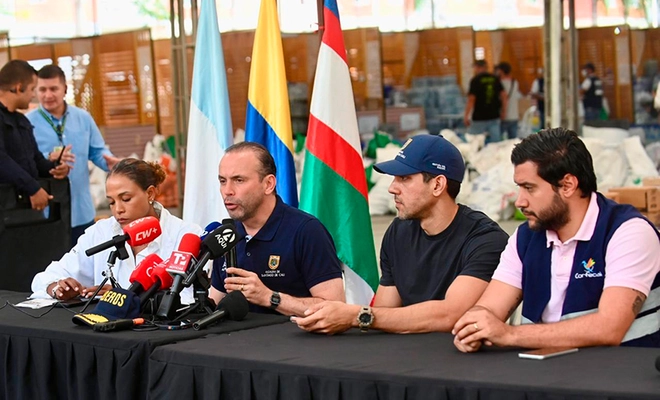
During the visit of the President of Colombia, Abelardo de la Espriella, to the Unified Command Post (PMU) led by the Mayor of Cali, Alejandro Eder, at the Ciudadela Petronio, the city’s mayor presented the current situation in the city following the earthquake that occurred last Monday, August 10, which affected the capital of Valle del Cauca, other municipalities in Valle del Cauca, and the departments of Chocó, Risaralda, and Caldas.
During this meeting, Mayor Alejandro Eder briefed President Abelardo de la Espriella on the progress of the emergency response in Cali and presented the latest report on search, rescue, and assistance efforts for affected families. As of 10:00 a.m. on August 15, Cali has recorded 88 people rescued, 77 missing, 111 fatalities, and 1.416 injured. Of the bodies recovered, 94 have already been returned to their families.
Regarding infrastructure, 46 buildings have suffered total collapse, 35 partial collapse, and 1.408 have sustained structural damage, while 533 buildings have been ordered evacuated. To date, 14,000 tons of debris have also been removed, 1.085 damage and needs assessments have been carried out, and 1.913 people remain actively engaged in emergency response efforts. In addition, 94 animals have been rescued.
Furthermore, the district mayor announced a measure aimed at strengthening oversight mechanisms for the emergency response and the management of resources and aid that have arrived in Cali.
“I want to inform the public that, given the magnitude of this emergency and the tremendous generosity we have received, I have made the decision to ask the Inspector General of the Nation for special and preventive oversight so that we can have absolute certainty, and so that the Colombian people can also be certain, that the resources are reaching where they are supposed to reach, within the appropriate timeframe.”
This assessment made it possible to understand firsthand the magnitude of an emergency that now poses enormous challenges for the recovery and reconstruction of the city. In this context, Mayor Alejandro Eder presented the President of the Republic with a series of requests aimed at addressing the emergency, redirecting resources to assist families who have lost everything, and establishing the necessary tools to move forward more quickly with the recovery and reconstruction of Cali.
“President, where are we going to get COP 10 billion from? We are talking about Cali, and we are in the middle of a regional crisis,” said Mayor Alejandro Eder, explaining the magnitude of the needs facing the city and the importance of having extraordinary tools to respond to the emergency.
In this regard, the district mayor proposed five measures to the National Government:
1. Extraordinary budgetary and tax powers:
The mayor requested that, taking advantage of the declaration of an economic emergency, a decree be issued allowing Cali, as well as the affected municipalities and departments, to make budgetary modifications more quickly, without having to complete the ordinary procedures before municipal councils and departmental assemblies for each modification. This tool would make it possible to access public resources more quickly to address the most urgent needs arising from the emergency, under the corresponding controls and safeguards of oversight agencies.
2. Redirection of specific revenues from stamp taxes
Mayor Eder proposed temporarily redirecting resources from stamp taxes toward emergency response efforts. In the case of Cali, there are approximately COP 350 billion in revenues earmarked for specific purposes which, under the current execution conditions, face difficulties in being used quickly. The proposal seeks to make these resources available to respond immediately to needs arising from the earthquake.
3. Redirecting Emcali’s debt to the Nation toward reconstruction
Another request presented was to incorporate into the recovery strategy the resources corresponding to the debt that Emcali owes to the Nation, amounting to nearly COP 2 trillion and originating approximately two and a half decades ago.
The mayor explained that these resources could be prioritized for the recovery of public utility systems, particularly Cali’s water supply system, but would also make it possible to complement the investments needed to restore affected infrastructure, such as hospitals, educational institutions, and housing.
4. Freezing rental rates in the affected areas
Mayor Eder also asked the National Government to adopt measures to prevent increases in rental rates in areas affected by the earthquake.
“We are seeing rents increase, and four days after the earthquake, that is not acceptable,” said the mayor, who asked the National Government to address this situation in order to protect affected families who currently need a safe place to live.
5. Authority to provide rental assistance
Finally, the mayor requested that mayors and governors in the affected areas be authorized to provide rental assistance to affected families who lost their homes or were forced to leave them as a result of the earthquake.
This measure would make it possible to provide an immediate response to those who require temporary housing solutions while assessment, recovery, and reconstruction efforts continue in the affected areas.
Mayor Alejandro Eder reiterated that the emergency does not end with search and rescue operations. The major challenge facing Cali and the region is to move forward with reconstruction that will allow public infrastructure, essential services, and housing to be restored and, above all, guarantee dignified living conditions for affected families.
“We need the tools to be able to respond. What we are proposing is how we can use the resources that already exist and how we can create the legal and budgetary conditions to rebuild our city,” concluded the mayor of Cali.
Communications Team, Office of the Mayor of Cali